
Short answer: every tattoo slowly softens, because the ink is held by immune cells that keep releasing and recapturing it, some pigment drains away, and sunlight breaks some pigments down. A thick line can absorb that change and still look like a line. A very thin line, or two lines placed very close together, cannot, which is why fine line tattoos tend to blur and fade sooner. The decisions that matter most are made before the needle: size, spacing, placement and how much detail you ask a small design to carry.
We make Tatany, an AI tattoo generator, and fine line is one of the styles people ask it for most. A screen shows a fine line design perfectly crisp at any size, which is exactly why it can mislead. This article explains what happens to ink in skin over the years, using published research where it exists and clearly labelled practitioner opinion where it does not, and turns it into checks you can run on a design before you book.
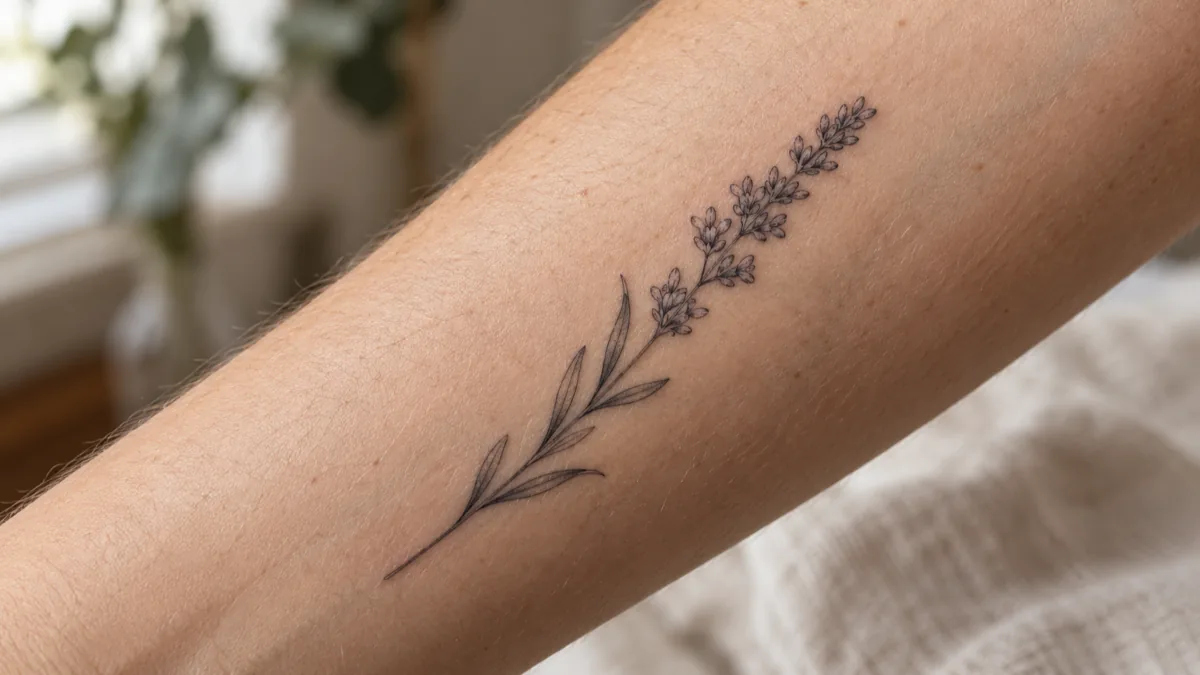
A fine line botanical piece while it is still crisp. Illustration made for this article.
What happens to ink after the tattoo heals
Immune cells hold the ink, and keep passing it on
For a long time it was assumed that tattoo ink simply sat in skin cells for life. A 2018 study in the Journal of Experimental Medicine, led by researchers at INSERM in France, found something more dynamic in mice. The pigment was held by dermal macrophages, immune cells that engulf foreign material. When those cells died, they released the pigment, and it was taken up again by new macrophages before it could disperse. The researchers described this capture, release and recapture as continuous.
That explains why tattoos last, and it suggests why they are never perfectly still. Two cautions: it was a mouse study, and as one dermatology researcher told Science News, human macrophages may live longer. And no study we found has measured how much this cycling widens a tattoo line. The idea that each cycle lets particles shift a tiny distance is a reasonable hypothesis, not an established fact.
Some ink drains away
Tattoo pigment is a mix of particle sizes. A 2017 study of human tissue in Scientific Reports found particles up to several micrometres across in the skin, but only particles smaller than about 200 nanometres in the nearby lymph nodes, strong evidence that the smallest particles migrate out of the skin over time. A study of nine samples of red tattooed human skin estimated that the amount of pigment had decreased by 87 to 99 percent years after tattooing. A tattoo can still be visible after losing most of its pigment, but it becomes lighter and softer.
Sunlight breaks some pigments down
Ultraviolet light is the factor you can most influence. A review in Current Problems in Dermatology notes that part of tattoo fading comes from photodegradation, and that some coloured azo pigments break down under light, while other pigment families were fairly stable in laboratory tests. In mice tattooed with a red pigment, 32 days of simulated sunlight reduced the pigment in the skin by about 60 percent. Mouse skin is not human skin, but the direction is clear.
Why thin lines suffer first
None of the processes above target fine line tattoos specifically. They happen to every tattoo. The difference is proportion.
Imagine the edges of every line softening by the same small amount. On a bold traditional outline, that change is a small fraction of the line's width, and the line still reads as a line. On a single-needle line, the same change can be a large fraction of its width, so it looks noticeably softer and lighter. And where two thin lines run close together, their soft edges meet, and the gap between them, which was carrying the detail, fills in.
That is the pattern people describe when a small fine line tattoo ages badly: not that it vanishes, but that details merge. Wing veins become a grey patch. The counters of small letters close up. A dotted line turns into a fuzzy smudge.
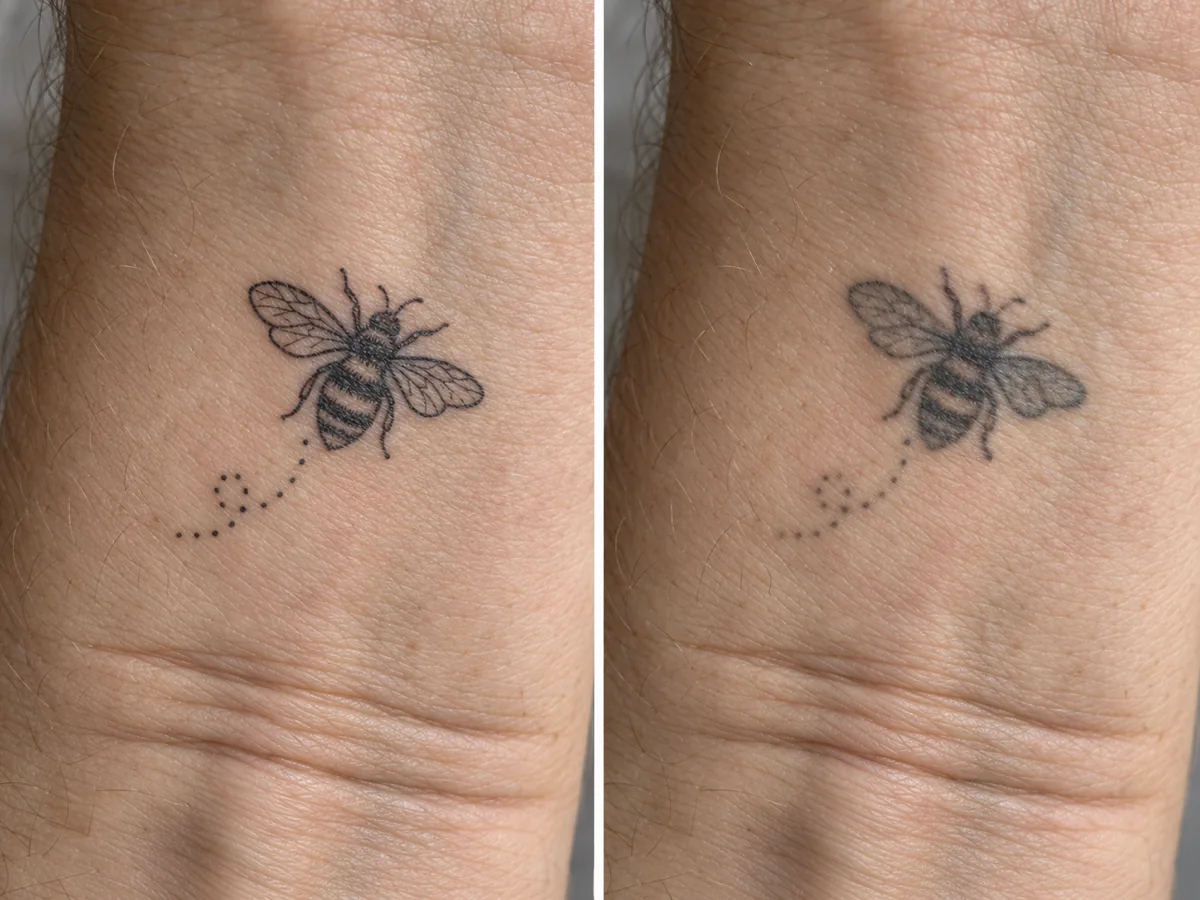
A simulated comparison: the same tiny bee freshly healed and as it might look after many years. The parts that blur first are the places where lines were closest together. Illustration made for this article, not a photograph of a real tattoo over time.
Blowout is something else
Blowout is often confused with ageing, but it is a different problem. A blowout is a blurry, bruise-like halo around lines that shows up soon after the tattoo, usually within several days. A case report in the Journal of Drugs in Dermatology describes it as pigment spreading outside the border of the tattoo, thought to happen when ink is placed too deep, and found pigment in the deeper dermis and the fat beneath it.
So the two have different causes and different fixes:
| Blowout | Gradual spread and fading | |
|---|---|---|
| When | Days to weeks after the tattoo | Over years |
| Looks like | Hazy blue-grey halo along lines | Lines slowly softening, lightening and merging |
| Main cause | Ink placed too deep or at a bad angle | Normal skin biology, pigment drainage and sunlight |
| What helps | An experienced artist, especially on thin skin | Design choices, placement, sun protection, touch-ups |
Healthline notes higher blowout risk where skin is thin, such as the top of the foot and the inner arm. Choosing an artist who does a lot of fine line work is the best protection.
How long fine line tattoos last: what artists say
There is no good study of how many years fine line tattoos stay crisp, and the numbers published by studios vary widely and come without data. Treat them as experienced opinion:
- Certified Tattoo Studios in Denver gives fine line work anywhere from 1 to 10 years before it needs attention, and warns that finger tattoos can become a faded mess within two years.
- The Black Hat Tattoo in Dublin suggests a light touch-up every 5 to 10 years for fine work, and says there is no universal millimetre rule for lettering.
- OSCO London lists fingers, the sides of the fingers, hands, wrists, the soles of the feet, ankles and the inner elbow as places that soften fastest, and the upper arm, shoulder, hip, back, outer thigh and collarbone as places that hold up better.
Hands and feet come up in almost every list. They get constant friction, sun and washing. If a fine line hand tattoo is what you want, go in expecting touch-ups.
Design checks to run before you book
Because you cannot change your biology, the most effective decisions are about the design itself. These checks follow from the mechanism above. None of them is a guarantee, and your artist's judgement beats any rule of thumb.
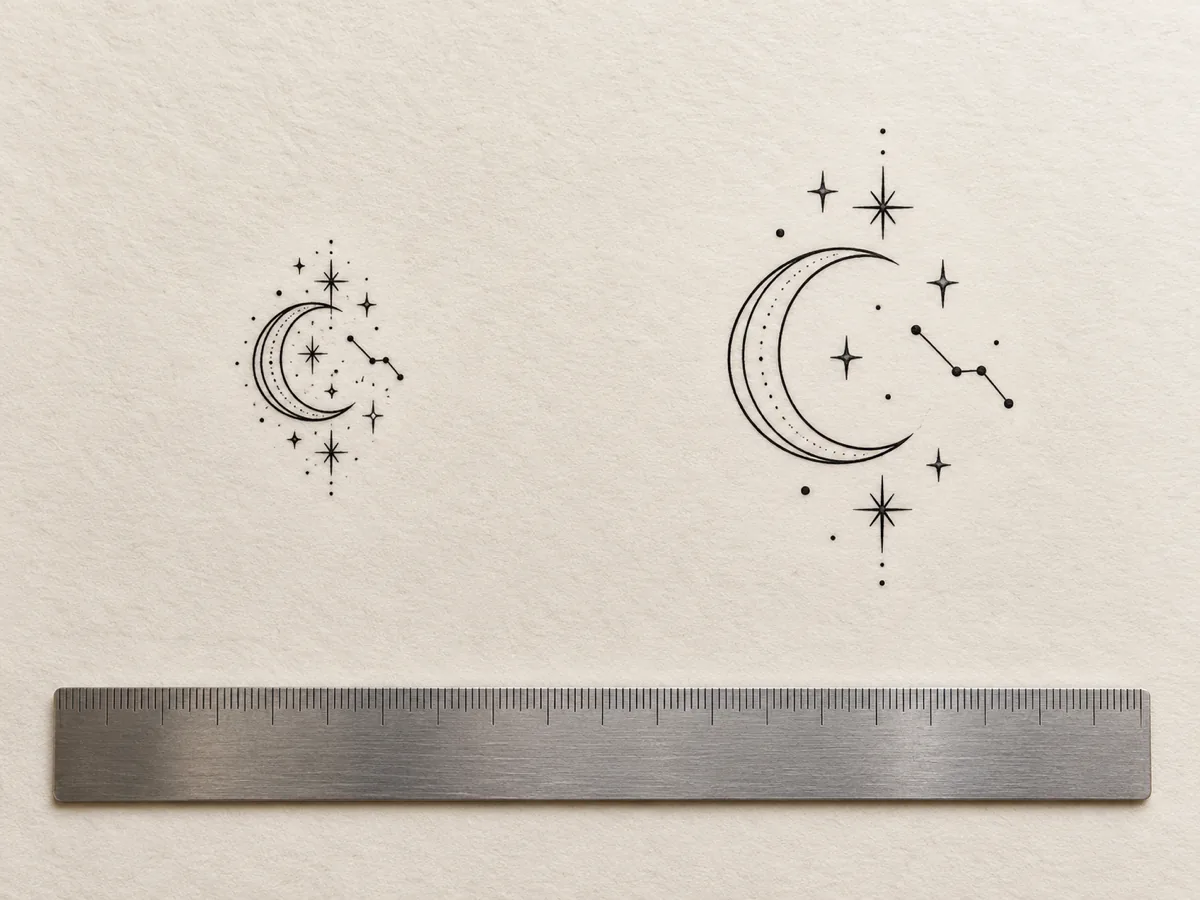
The same moon motif drawn small and crowded, and larger with open spacing. The right version has room for its lines to soften. Illustration made for this article.
1. The doubling test
Look at your design at its real size and imagine every line twice as thick. This is a stress test, not a prediction of how much your lines will spread. Wherever two lines would touch, or a small shape would fill in completely, that area is likely to blur first. Either open up the space there, make the design larger, or remove that detail.
2. Give the design enough size for its detail
Detail and size are linked. If you want a lot of elements, the design has to be bigger. If you want it small, it has to be simpler. For lettering, Vatican Tattoo in Florida advises avoiding tiny script under about 3 to 4 millimetres in capital height. Other studios refuse to give a single number, and your artist will know what their own technique can hold.
3. Keep negative space open
Open skin between lines is what lets a fine line tattoo stay readable. Avoid tightly packed hatching, tiny stipple fields and fine textures in small designs. Use a few confident lines rather than many faint ones.
4. Make the outline the strongest line
A design where every line has the same weight has nothing to fall back on as it softens. A slightly heavier outer contour keeps the silhouette readable even when interior detail fades.
5. Choose placement with the lifespan in mind
If crispness matters to you, the lists above point toward the upper arm, shoulder, back and thigh, and away from fingers, hands and feet.
6. Look at it from across the room
Print the design at its real size, tape it to a wall, and step back two or three metres. If you cannot tell what it is from there, the small details are doing too little work. Tatany's Pro and Studio plans export a print PDF at an exact width in centimetres for this kind of check, but any printer and a ruler will do.
If you are generating concepts, the Simple complexity setting in our AI tattoo generator asks the model to drop decorative micro-details and keep gaps open between features, a good starting point for anything small. Our guide to writing an AI tattoo prompt explains how to state size and line logic in the prompt itself.
Aftercare and sun protection
Once the tattoo has healed, sun protection is the most useful habit. The American Academy of Dermatology says ultraviolet light can fade some tattoo inks, and recommends a broad-spectrum, water-resistant sunscreen with SPF 30 or higher on tattooed skin, applied before going outside and reapplied at least every two hours. It also warns that tanning beds can fade tattoo ink.
We found no controlled study in people measuring how much sunscreen slows tattoo fading, so be wary of precise claims you see online. The evidence is indirect: pigments break down under light in the lab, and sunlight reduced pigment in tattooed mice. That is good enough reason to cover up, and your skin benefits anyway.
During healing, follow your artist's aftercare instructions, including how to keep the new tattoo out of the sun until the skin has closed.
The bottom line
Fine line tattoos are not a mistake. They are a style with a shorter margin for error. Choose an artist who specialises in fine line work, give the design the size its detail needs, keep space between lines, think about placement, and protect it from the sun. Then plan on a touch-up at some point, the same way you would for any tattoo you want to keep looking sharp.
Before you book, read how to bring an AI tattoo design to your artist, and if you are converting a design into linework for your artist, our tattoo stencil generator turns a design or photo into clean outlines.