Short answer: many tattoo artists will accept an AI-generated image as a reference, the same way they accept a Pinterest screenshot or a photo of your dog. Very few will tattoo it exactly as generated, because AI images are drawn for screens, not skin, and some artists decline AI references altogether. Ask before you book, present the image as a starting point, and expect the artist to redraw it.
We make Tatany, an AI tattoo generator, so we have an obvious interest in artists being open to AI concepts. That is also why we want people to arrive at the studio with the right expectations. Nothing in this article is a promise about any particular artist. Studios set their own policies, and the artist is always the one who decides what goes on your skin.
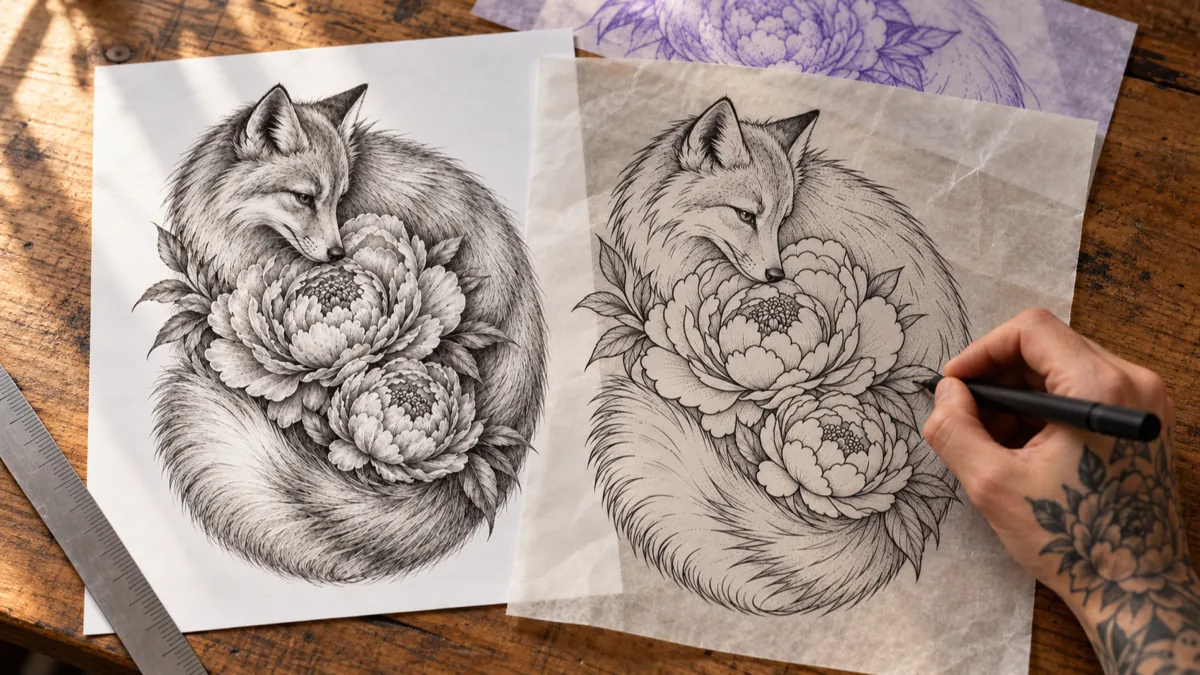
An AI concept on the left, the artist's redraw on tracing paper on the right. Illustration made for this article.
Why artists redraw almost every design
Redrawing is not a reaction to AI. Tattoo artists have always redrawn what clients bring in: a sketch on a napkin, a tattoo from someone else's arm, a painting from a museum. The reasons are practical.
- Skin is not paper. Ink lines settle and spread slightly as they heal and over the years. Details that sit too close together merge. Artists adjust spacing and line weight so the tattoo still reads in ten years. Our guide on why fine line tattoos blur explains the biology.
- Size sets the detail. A design has to be drawn for its real size. A concept that works at 20 cm loses most of its detail at 7 cm.
- The body is curved and moves. A forearm tapers, a calf twists, a ribcage rises and falls. Artists bend and rebalance a design so it flows with the muscle rather than sitting on it like a sticker.
- The tattoo has to become a stencil. Before tattooing, the design is printed or traced onto transfer paper and pressed onto the skin as a purple guide. Stencil paper makers such as HPRT advise clean, bold lines and simplifying very detailed designs before printing, because faint or fuzzy marks do not transfer well. The artist decides which lines go on the stencil.
So the real question is not "will they tattoo my AI design" but "will they work from it". For many artists the answer is yes, if you ask well.
What AI concepts usually get wrong for skin
Image models are trained to produce attractive pictures. When an artist looks at an AI concept, these are the problems they tend to spot first:
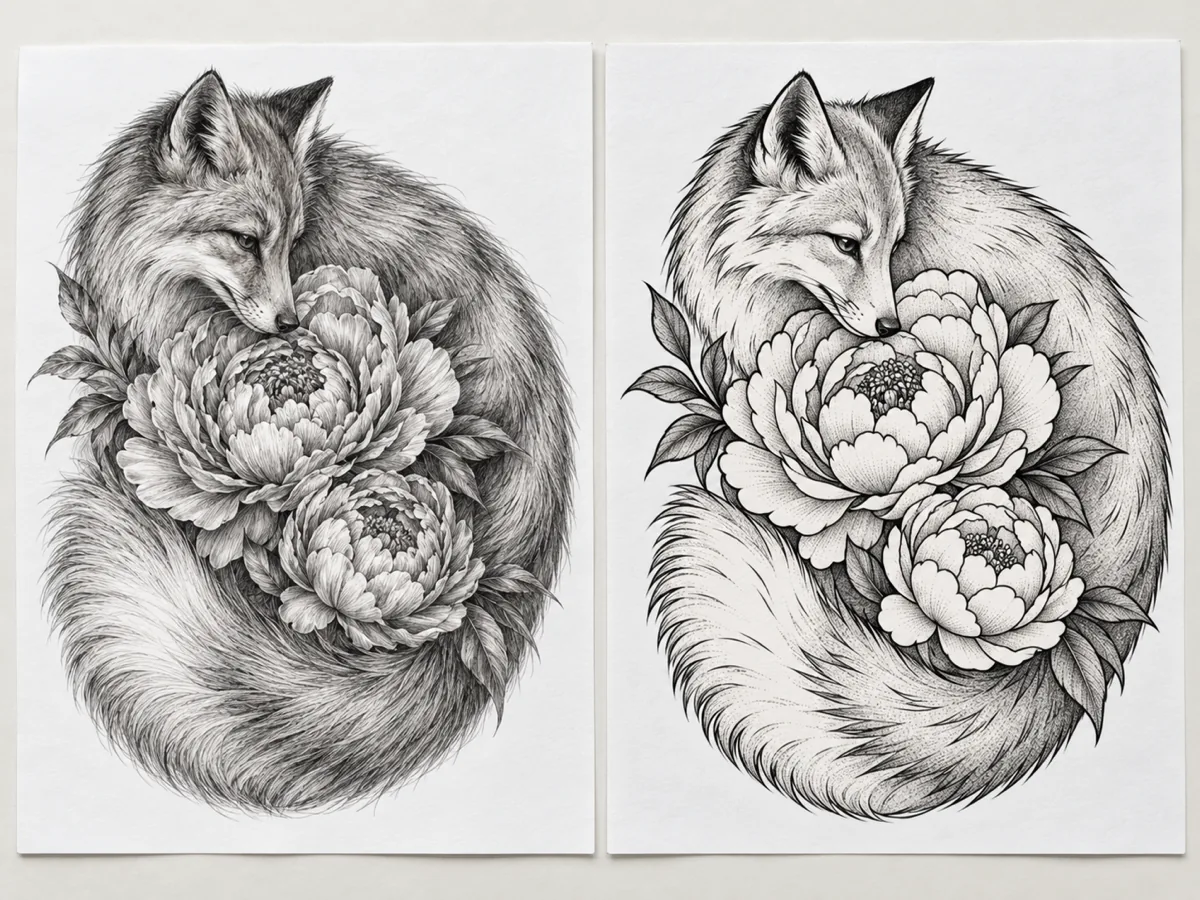
Same composition, two levels of detail. The right side is what an artist typically does to make it work in skin. Illustration made for this article.
- Too much fine detail. Hundreds of hair-thin fur or texture lines packed together. On skin they blur into a grey patch.
- Photographic gradients. Smooth airbrush-like tone that a needle can approximate only with careful shading, and that may not hold at small sizes.
- No line hierarchy. Every line the same weight, so nothing reads as the outline from a distance.
- Anatomy and logic errors. Extra petals growing from nowhere, a paw with the wrong number of toes, a snake whose body does not connect.
- Lettering mistakes. Misspelled or invented words, especially in scripts and languages you do not read.
- Wrong shape for the placement. A square composition for a long forearm, or a design that would need to wrap around a limb but was drawn flat.
These are not our guesses. They match what working artists tell reporters. In an ABC News report from August 2026, Adelaide artists listed misspelled words clients had not noticed, repetitive and over-detailed images, and an extra finger; one said some of the tiny details "just cannot physically be done" on a hand or leg. Brighton artist Hannah Reynolds told Dazed she would never tattoo an exact copy of an AI design but will use one as a starting point, and named the same problems: too much detail, wrong proportions, spelling errors.
None of these mean the concept is useless. They are exactly what an experienced artist fixes, and the concept still shows them the subject, mood, composition and style you want, which is the hard part to communicate in words. If you write your own prompts, our AI tattoo prompt guide shows how to avoid most of these at the source.
How common AI references are, and why some artists say no
There is no industry-wide survey of how many clients bring AI designs or how many artists accept them; the numbers you see quoted online usually have no traceable source. What exists are individual artists' estimates. In the ABC report, one Adelaide artist estimated about one in four enquiries included AI imagery and another about three in four. A Hungarian artist told Euronews in September 2026 that around 70% of her customers arrive with AI images, and that she uses AI for references herself. So it is common, and attitudes range from enthusiastic to firmly opposed.
Some artists will not work from AI images at all, and it is worth understanding why rather than arguing.
- Training data. Many image models were trained on large collections of images from the web, which include artwork by tattoo artists who never agreed to it. London artist Klaudia Kempa told Dazed she would never tattoo an AI image, partly because AI can copy other artists without anyone realising; Euronews quotes Dan Gold's main concern as where the training data comes from.
- Style imitation. Prompts that ask for a design "in the style of" a named living artist copy someone's signature look. Artists, understandably, do not want to recreate a colleague's work for a client.
- Custom drawing is the job. Many artists see drawing your design as the core of what they offer, and a client arriving with a finished image can feel like the creative part has been skipped.
- Unrealistic expectations. A client who expects the tattoo to look exactly like a flawless screen image is likely to be disappointed, and artists have learned to avoid that conversation.
Even sceptics see a use. Brenton Eldridge of the Professional Tattooing Association of Australia told the ABC that AI cannot account for how designs heal or age, but can be a useful way to prototype ideas. That is the role this article recommends.
The respectful response is simple: if an artist's booking page says no AI references, find another artist or describe your idea in words and old-fashioned reference photos. And never prompt with a living tattoo artist's name.
How to ask before you book
Most studios take enquiries through a booking form, email or direct message. A clear first message saves both of you time. Something like:
Hi, I'd like a black and grey piece on my outer left forearm, about 15 cm tall: a fox curled around peonies. I made a few AI concepts to show the composition and mood I'm after. I'm not expecting them to be tattooed as they are; I'd love you to redraw it in your own style. Are you open to working from AI references? Images attached.
This message does four things: it gives placement and size, it describes the subject in words, it is upfront about the AI, and it makes clear you are asking for the artist's version, not a copy. That last point is what most artists want to hear.
Choose an artist whose portfolio already looks like your concept. If your idea is fine line botanical, look for someone who does a lot of fine line botanical work. An AI image does not make up for a mismatch between your idea and the artist's specialty.
What to bring to the consultation
- The concept, plus a few runner-up versions. Seeing what you rejected tells the artist as much as what you chose.
- Notes on what you love and what you are unsure about. "The fox's pose is right, I'm not sure about the leaves" is useful direction.
- Placement and size. Measure the area on your body with a tape measure. If you have the design at the right size on paper, even better.
- Photos of the placement, especially if there are existing tattoos, scars or birthmarks nearby.
- Colour or black and grey, and your budget.
On Tatany's Pro and Studio plans you can export a print PDF at an exact width in centimetres, with a ruler on the page to check the scale, which helps you judge whether a size works before the appointment. A tape measure and a printed copy at home work too.
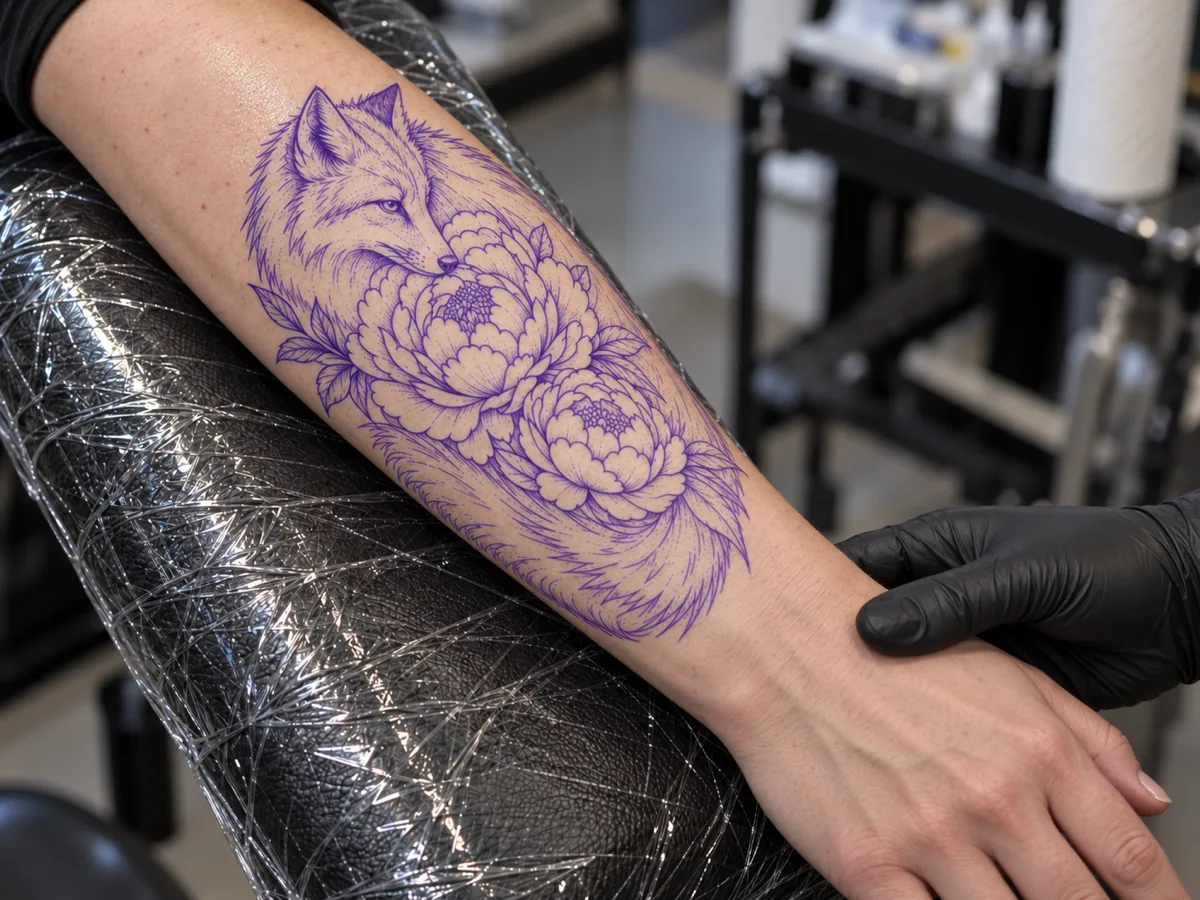
The artist's redrawn design as a stencil on the skin, the last chance to adjust size and position. Illustration made for this article.
What happens next
Practices vary, but the usual sequence is:
- Deposit. Most studios take a deposit to book, usually non-refundable and put toward the final price. Amounts vary widely: Sang Bleu London lists a £50 deposit, while Certified Tattoo Studios in Colorado asks for 50% of the price. Some artists charge a separate drawing fee for custom work, or fold it into the deposit.
- The artist draws. They redraw your concept at the real size, simplifying, adjusting line weight and fitting it to the placement. Some share the drawing in advance; many show it on the day.
- Stencil and placement. On the day the design is printed as a stencil and placed on your skin. This is when you check size, angle and position in a mirror. Speak up now; moving a stencil is easy, moving a tattoo is not.
- Tattooing. The stencil is a guide. Shading and many fine details are done freehand.
Expect the final drawing to differ from your concept. If the artist simplified it, that is usually the expertise you are paying for.
Who owns an AI tattoo design?
This is general information, not legal advice, and the law differs between countries and is still developing.
In the United States, copyright protects human authorship. The Copyright Office's 2023 registration guidance compares prompts to instructions given to a commissioned artist: when the AI determines the expressive elements, that material is not protected. Its January 2025 report on copyrightability repeats that prompts alone are not enough, while a person's creative arrangement or modification of the output, or their own drawing that remains visible in it, can be protected. In Thaler v. Perlmutter, a federal appeals court held in March 2025 that the Copyright Act requires a human author, and the Supreme Court declined to hear the case in March 2026.
In practice, for a tattoo:
- Your AI concept may not be protected by copyright in many places, which also means you probably cannot stop someone else using a similar image.
- The artist's redrawn version is likely to be treated differently, because a person made the creative changes. US courts have recognised tattoo artists as copyright holders in their designs, for example in the video game cases over tattoos on athletes. Many artists keep their drawings and do not hand over files.
- The terms of the tool you used decide what you may do with the output. Tatany claims no ownership of your prompts or designs. On a free account, designs are for personal use; paid plans include a commercial-use licence. See our terms of service for the details.
Quick answers
Can I get an AI tattoo design tattooed exactly as it is? Rarely, and you probably should not want to. An artist will adapt it for size, skin and placement so it heals and ages well.
Is it rude to bring an AI design? Not if you ask first and present it as a reference. It is rude to insist on an exact copy, or to bring a design that imitates another artist's style.
Will the artist charge less because I brought a design? Usually not. The artist still draws, sizes and stencils it, and the time on the chair is the same.
What if the artist wants to change a lot? Ask why. Their reasons are usually about how it will look in five or ten years, which is something a screen cannot show you.
Ready to explore an idea before you book? Sketch a few directions in the AI tattoo generator, or upload a drawing to image to tattoo, then take the best versions to an artist you trust.