
Short answer: new tattoo ink does not erase old ink; it sits alongside it in the skin, and the darker pigment wins. So a cover-up works by putting the darkest, densest parts of a new design over the old one, and the new design usually has to be noticeably larger. Light colours, fine line work and open negative space cannot hide dark old ink. If the old tattoo is very dark, very new or very large, a few laser sessions to fade it first can open up far more design options.
We make Tatany, which includes an AI tattoo cover-up preview tool. A preview can help you think about composition; it cannot tell you whether a real cover-up will work. That judgement belongs to an experienced artist looking at your skin. This guide explains the reasoning they use, so you walk into the consultation with realistic expectations. Practitioner figures below are attributed to the studio or clinic that published them, and they are estimates, not rules.
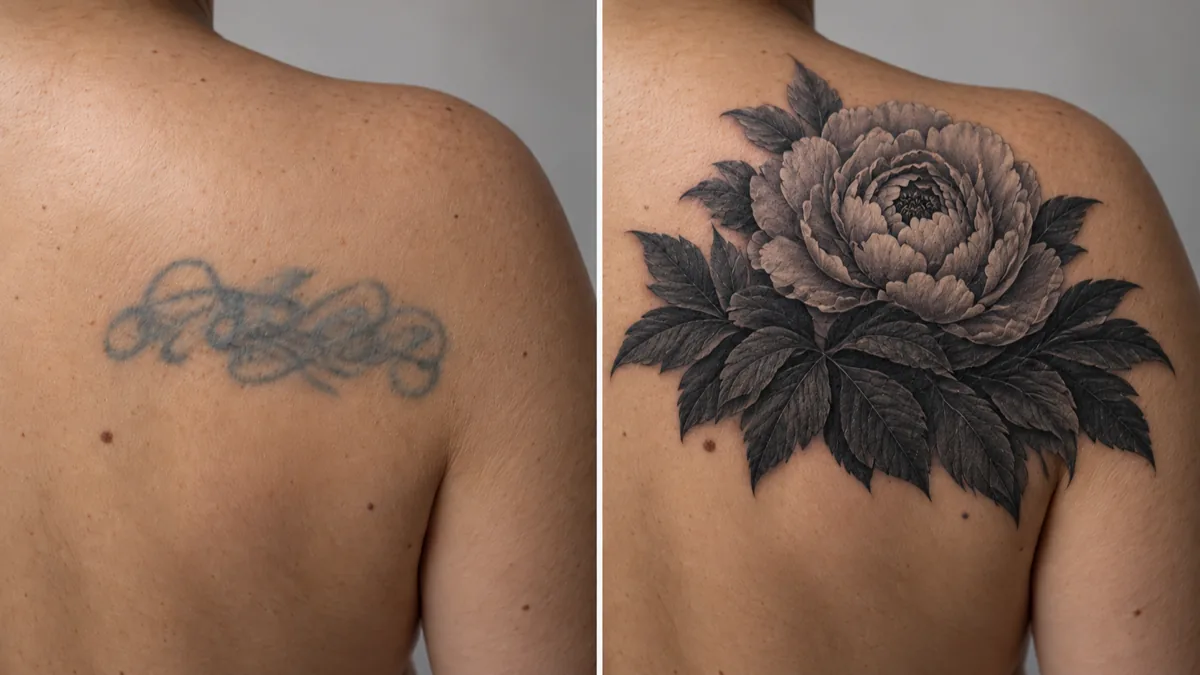
A typical cover-up logic: the dark leaves and shadows of the new piece sit where the old script was. Illustration made for this article.
Why new ink cannot cancel old ink
Tattoo pigment lives in the dermis, the layer of skin beneath the surface. Research in mice published in the Journal of Experimental Medicine in 2018 found that the ink is held inside immune cells called macrophages, and when those cells die, new macrophages take the same pigment back up. That is why a tattoo stays put for decades, and also why an old tattoo is still there, ink and all, when an artist starts on top of it.
A cover-up adds a second set of pigment to the same area. The two do not cancel; they combine. Ink Well, a studio in Kingston, Ontario, puts it plainly in its cover-up guide: the two colours combine to make a new colour, and the darker one dominates. United Tattoo in Colorado says the same in its pre-booking advice: lighter colours placed over dark ink will not erase it.
From that one fact, most of the practical rules follow.
What can cover what
| Old tattoo | What can cover it | What usually fails |
|---|---|---|
| Light colour (yellow, pink, light blue) | Most darker colours and black and grey | Similar or lighter tones |
| Faded black or blue-black | Dense black and grey, deep blues, greens, purples, solid black areas | Fine line, minimalist, watercolour washes |
| Bold, saturated black | Heavier black work, often after laser fading; sometimes a blackout | Anything relying on light colour or open skin over the old lines |
| Very fresh tattoo | Often better to wait | Covering before it has fully settled |
Two notes on the table. First, black is the hardest to cover because nothing is darker than it. Certified Tattoo in Colorado calls black tattoos some of the most difficult to cover. Second, Mechanical Concept Tattoo in California notes that newly done tattoos are especially hard because their colour is at its most saturated. If you regret a tattoo you got recently, waiting is part of the plan.
How much bigger does a cover-up need to be?
This is the question people ask most, and the published answers look contradictory:
- Ink Well and Mechanical Concept both say a cover-up is often around two to three times the size of the original.
- Majestic Tattoo in New York says the new piece should have about double the surface area and cannot be the same size.
- Certified Tattoo notes that a small original can sometimes be covered by a design of similar size.
Part of the confusion is that "size" can mean two different things: the height and width of the design, or its area. They grow at different rates. Make a design 1.5 times taller and 1.5 times wider and its area is 2.25 times larger. Double the height and width and the area is four times larger.
| Increase in height and width | Increase in area |
|---|---|
| 1.25 times | about 1.6 times |
| 1.5 times | 2.25 times |
| 1.75 times | about 3.1 times |
| 2 times | 4 times |
So "two to three times the size", read as area, means a design only about 1.4 to 1.7 times as tall and wide as the old one. Read as height and width, it means four to nine times the skin. When an artist gives you a number, ask which they mean. And remember the reason the cover-up has to grow: the new design needs dark, dense areas big enough to sit over every old line, plus room around them for the lighter parts that make it look like a design rather than a patch.
Designs that hide old ink, and designs that cannot
What a cover-up needs is a lot of controllable darkness in the right places. Studios repeatedly recommend the same families of subject:
- Flowers and foliage. Peonies, roses and dense leaves give organic shapes, overlapping petals and natural shadow.
- Animals and creatures. Ravens, panthers, wolves, koi and dragons carry dark fur, feathers or scales that absorb old lines.
- Japanese work. Waves, wind bars and dark backgrounds can absorb old shapes across a large area.
- Blackwork and ornamental panels. Large solid black areas, with pattern around them.
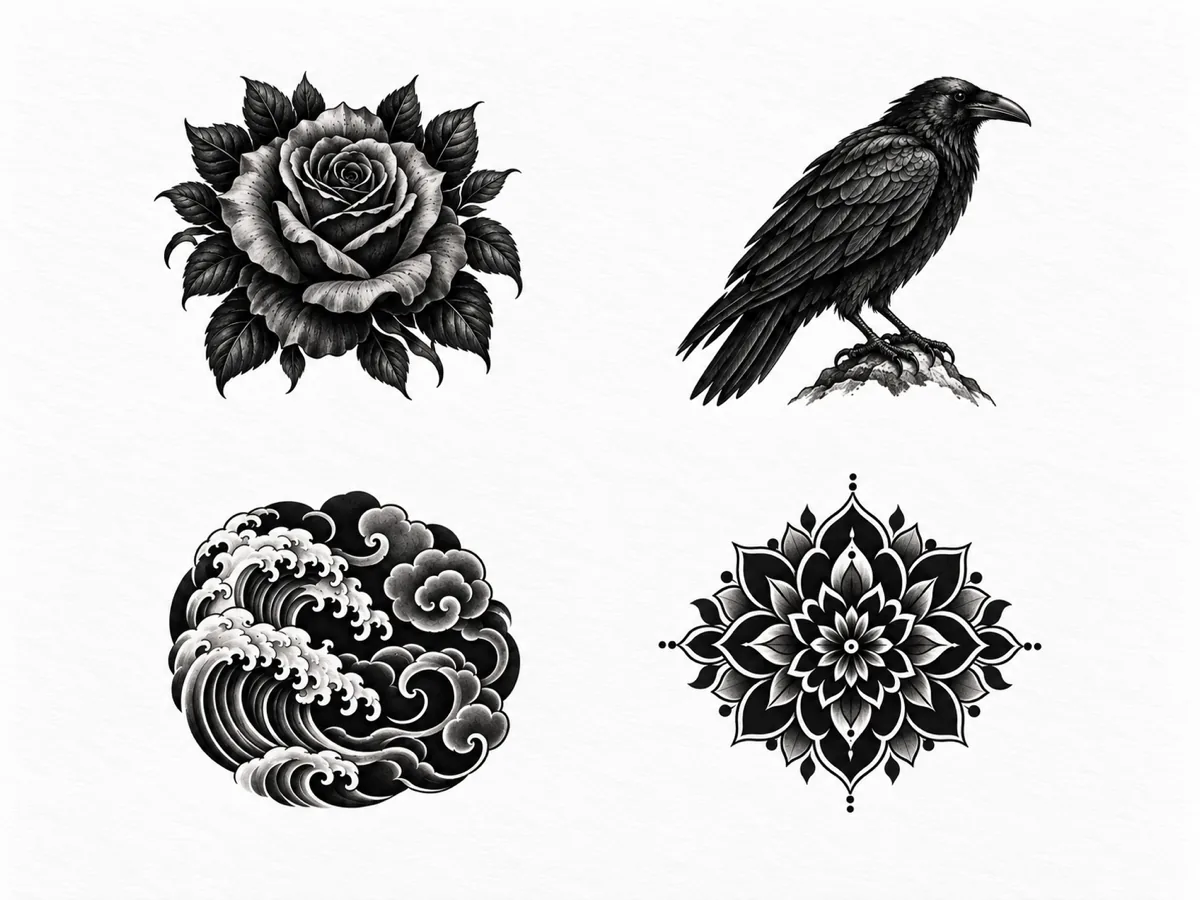
Four design families that suit cover-ups because each has large dark masses. Illustration made for this article.
What struggles, according to the same studios: fine line, minimalist, and soft watercolour. United Tattoo writes that fine line is usually not the best tool for covering dark existing work. The reason is the same in each case: those styles rely on thin lines and bare skin, and bare skin is exactly what you cannot have over old ink.
Shape matters too. A design whose dark forms follow the old tattoo's outline needs less extra size. Curves suit curves: a rounded flower over a rounded old design hides it more easily than a set of straight geometric lines would.
How artists plan the coverage
The process most cover-up artists describe looks like this:
- Map the old tattoo. The artist photographs or traces it and notes where the ink is darkest and most saturated.
- Put the darkest parts of the new design there first. United Tattoo describes it as placing the darkest parts of the new design over the darkest parts of the old one.
- Build the rest of the design around those anchors. Lighter elements, highlights and open skin go only where there is no old ink underneath.
- Check the edges. Old lines that stick out past the new design are where cover-ups give themselves away.
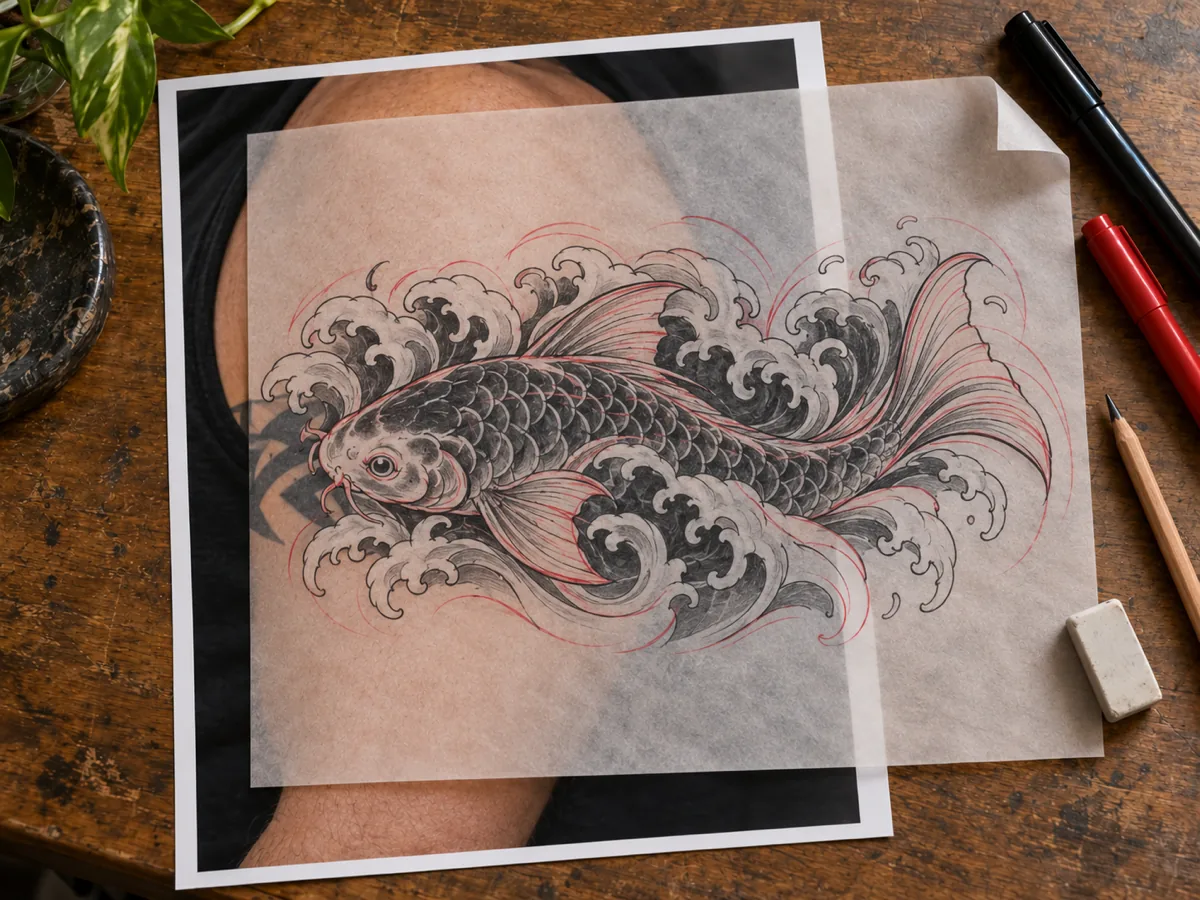
Planning on tracing paper: the koi body and wave shadows are placed over the old tribal shapes first. Illustration made for this article.
This is also how we tell our own preview tool to work. When you mark an old tattoo in Tatany's cover-up tool and choose Full Cover, the image model is instructed that the old ink cannot be erased, that the marked area should become the darkest part of the new design, and that most of that area should be solid black or dense dark shading. The output is still an image, not a promise. Real skin, scars and healing will differ, and an artist may decide the idea needs laser fading or more size.
Cover-up, rework or blackout?
Not every unwanted tattoo needs to disappear under a new subject.
- Cover-up: new art designed to hide the old design, without removing pigment.
- Rework: the old tattoo is kept and improved, with stronger lines, fresh shading or new elements around it. Good for a tattoo you mostly still like that has blurred or faded. Tatany's tool calls this mode Rework & Extend.
- Blackout: an area is filled with solid black ink. Certified Tattoo describes blackout cover-ups as a way to fully obscure an old tattoo, which can later serve as a base for other designs. It is a big visual commitment and usually takes more than one session.
- Laser removal: taking the pigment out instead of hiding it, which leaves you free to do nothing, or anything.
When to laser-fade first
Laser fading breaks up some of the old pigment so the body can clear it, which lightens the tattoo without removing it fully. It gives a cover-up artist more freedom: smaller sizes, lighter colours, and less dependence on solid black.
How many sessions? The Cleveland Clinic says full removal usually takes six to twelve visits and sometimes more. Fading for a cover-up needs fewer. Ray Studios, a removal clinic, estimates two to five sessions before a cover-up, spaced about six to eight weeks apart. Your number depends on the ink, your skin and how much lightening the artist wants.
A few cautions:
- Not every colour responds the same. The American Academy of Dermatology notes that a single laser cannot remove all ink colours. The Cleveland Clinic says blue and black respond well, which is good news for the inks that are hardest to cover.
- Choose a qualified provider. Treatment by someone untrained can cause burns and scars, and scarred skin takes new ink less predictably.
- Wait before tattooing. Platinum Ink, a studio in Austin, asks clients to wait six to eight weeks after the final laser session before a cover-up, and longer if they heal slowly.
As a rough illustration, not a sourced figure: three fading sessions eight weeks apart, then an eight-week wait, means the cover-up starts about six months after the first laser appointment. Plan around that if you have a date in mind.
How to prepare for a cover-up consultation
Good cover-up artists turn down jobs they do not think will work, and they need information to decide. Bring:
- Clear photos of the old tattoo. Straight-on, in daylight, plus one wider shot that shows where it sits on the body. Majestic Tattoo asks for at least three photos from different angles and in different light.
- Its age and history. When it was done, whether it has been lasered, and whether there is scarring or raised lines.
- Your size limit. How far the new piece can extend before it touches other tattoos or areas you want to keep clear.
- Two or three directions you like, rather than one fixed design. The artist will steer you toward the subject that covers best.
- Openness on colour and darkness. If you insist on light colours over dark ink, the honest answer may be laser first.
If you want to see directions before the consultation, the AI tattoo cover-up tool previews a new design over a photo of your own skin. Use it to compare subjects and density, then let the artist decide what will truly hide the old work. For a fresh design that does not need to cover anything, start with the AI tattoo generator instead, and read how to write an AI tattoo prompt for the details that make a concept usable.